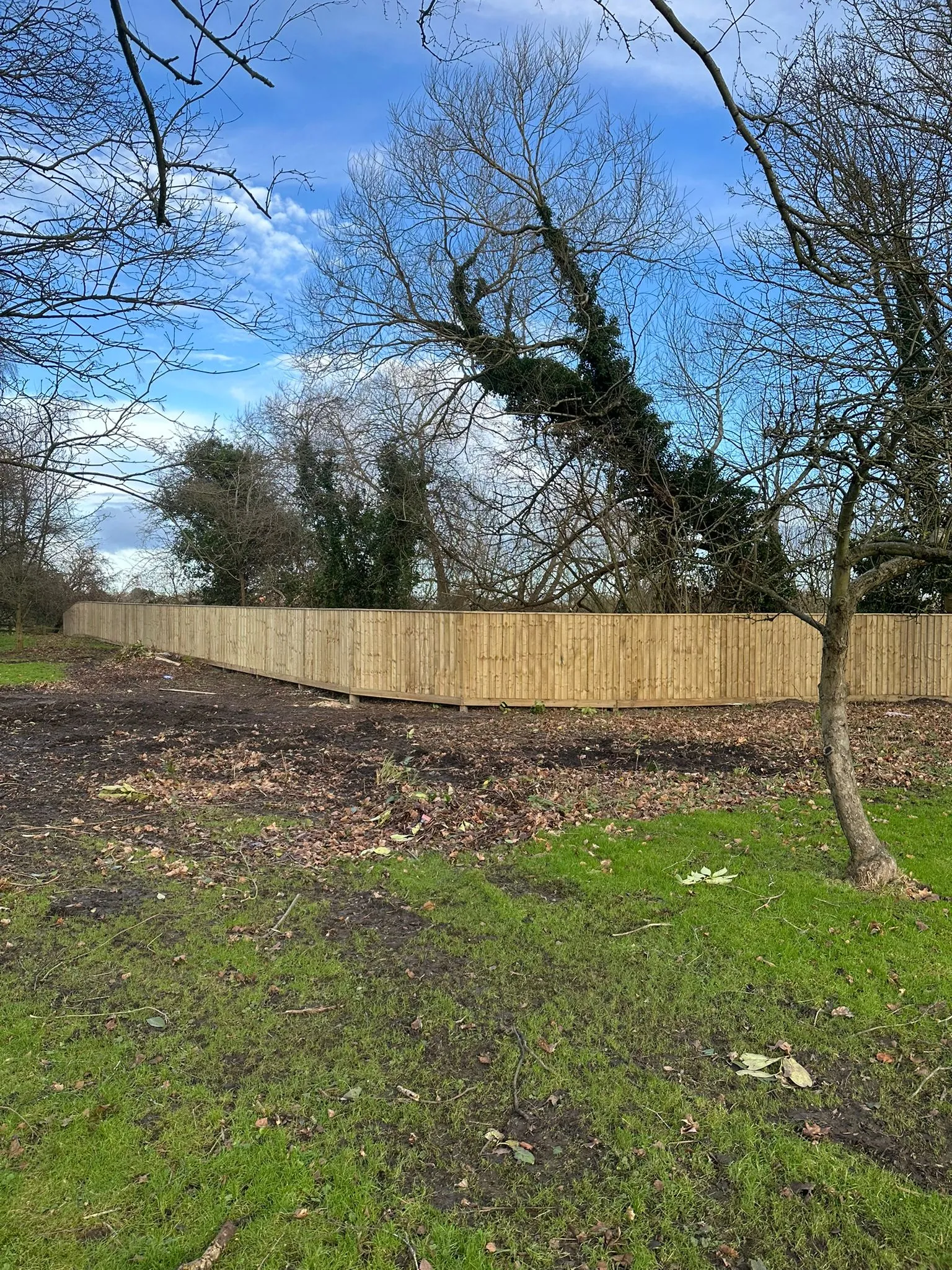
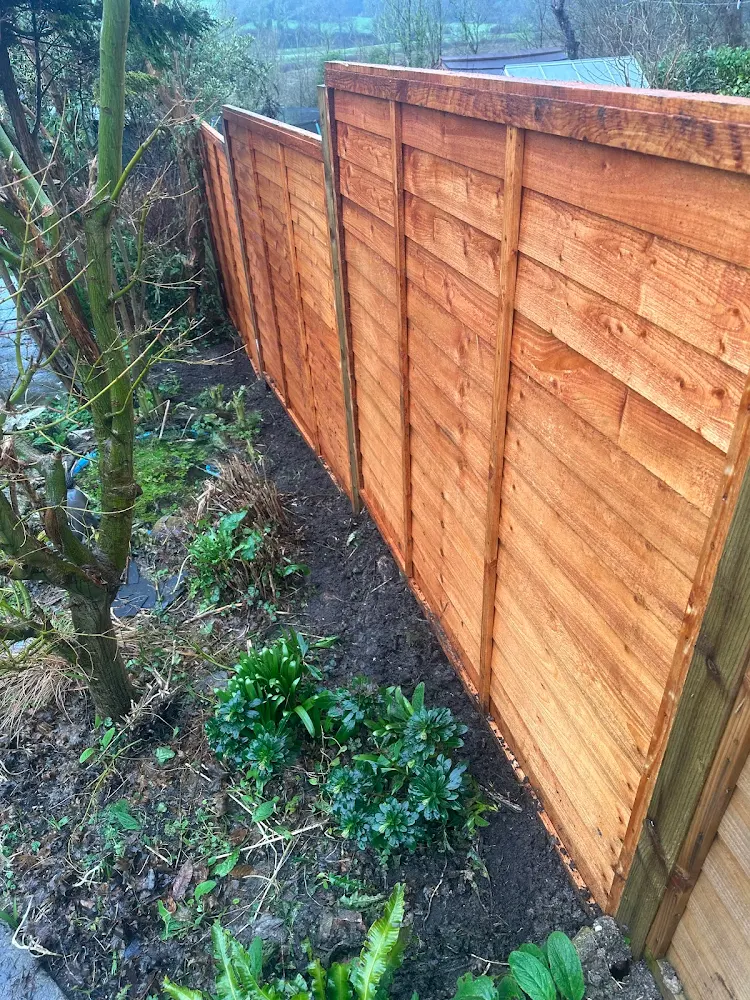
Not every North Devon garden sits neatly in a sheltered valley. Some are perched right up on the edge of a hill, fully exposed to whatever the Atlantic throws at them. This project in Great Torrington was exactly that, and it is a perfect example of why the right fence design matters just as much as the quality of the installation.
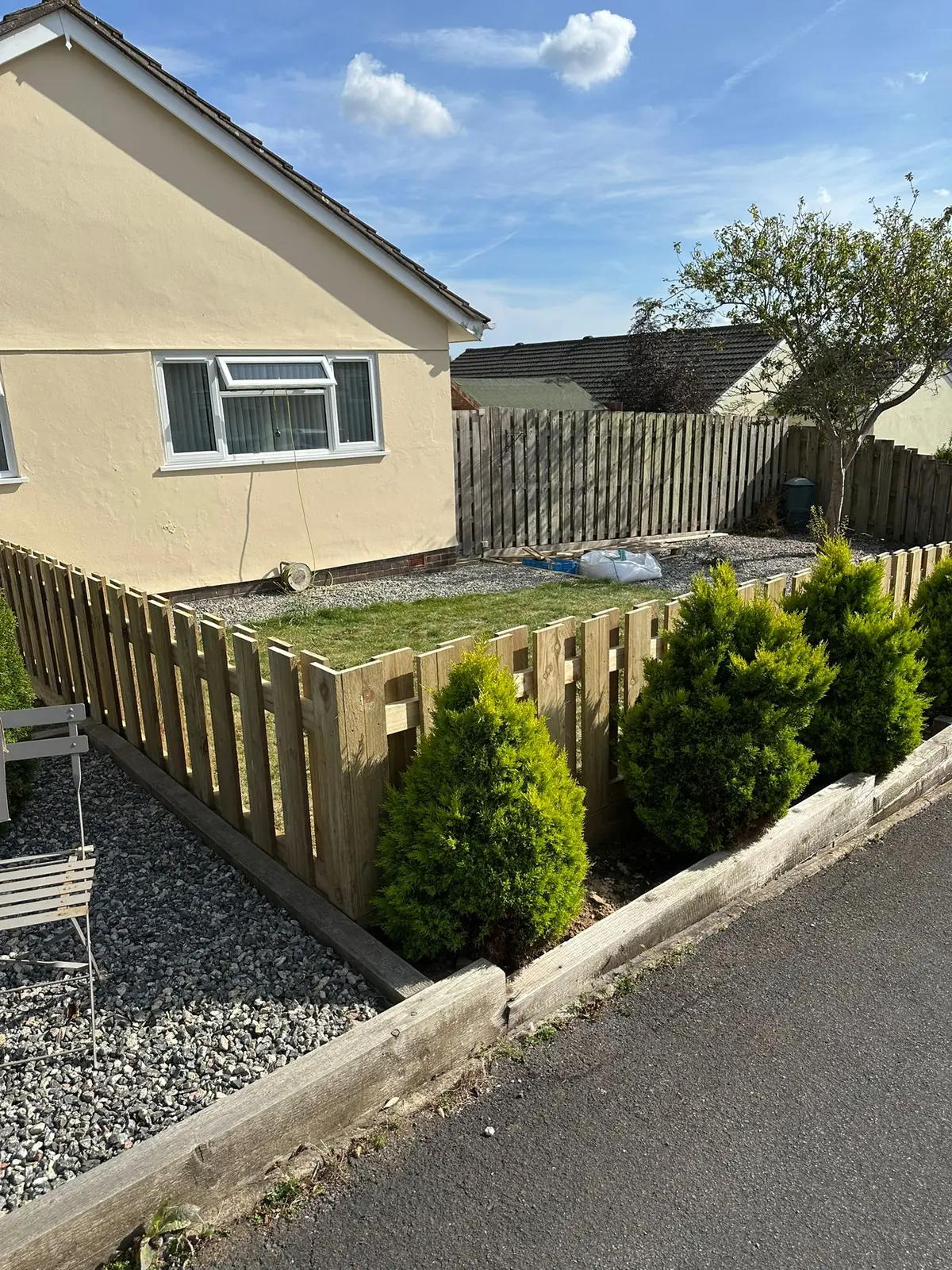
The customer came to us with two straightforward requirements: a fence at the front to keep the dog in, and a clear, attractive boundary to define the front garden from the lane. The complication was the wind. Great Torrington sits high up above the Torridge Valley, and the front of this property caught the full force of every gust. A solid panel fence would have acted like a sail and been on the ground within a winter or two. The solution we built was a custom hit and miss fence with a matching gate, cut to height to stay within the legal limit for a boundary facing a highway.
The Site: Great Torrington, High on a Hill
Great Torrington is a small market town in North Devon, perched on a hilltop above the River Torridge with sweeping views across the valley towards Bideford and the coast. That elevation is what gives the town its character, and its views, but it also makes it one of the more exposed spots in the area. When the wind comes in off the Atlantic, it funnels up the Torridge Valley and hits the higher ground around Torrington hard.
The property we were working on sat near the top of the town, with the front garden facing directly onto a lane. There was no shelter from neighbouring buildings on the windward side, and the garden was wide open to the prevailing south westerlies. The customer had lived there long enough to know exactly what the weather could do, and she was very clear that she did not want a fence that would blow down every winter.
She also had a dog that she wanted to be able to let out into the front garden safely, and she wanted a smart boundary that would mark the garden off from the lane without the closed-in feel of a tall solid fence. So the fence needed to do three things at once: contain the dog, define the boundary, and survive the wind.
Why a Solid Fence Was the Wrong Choice
The instinct for a front boundary is often to reach for a solid panel fence. On a sheltered suburban estate, that is a reasonable choice. On an exposed hilltop in Torrington, it is a recipe for a recurring repair bill.
A solid fence presents a flat, unbroken face to the wind. The wind hits the panels, has nowhere to go, and transfers all of its force directly onto the posts and the panel fixings. The higher and longer the fence, the bigger the sail area and the larger the load. In a storm, that load can run into hundreds of kilos of force per panel. Timber posts bend, concrete posts snap at the ground line, and panels blow out of their slots.
We have replaced plenty of fences across North Devon that failed for exactly this reason. The fence was not badly built, it was simply the wrong type of fence for the conditions. On an exposed site, you need a fence that lets the wind through.
The Solution: Hit and Miss Fencing
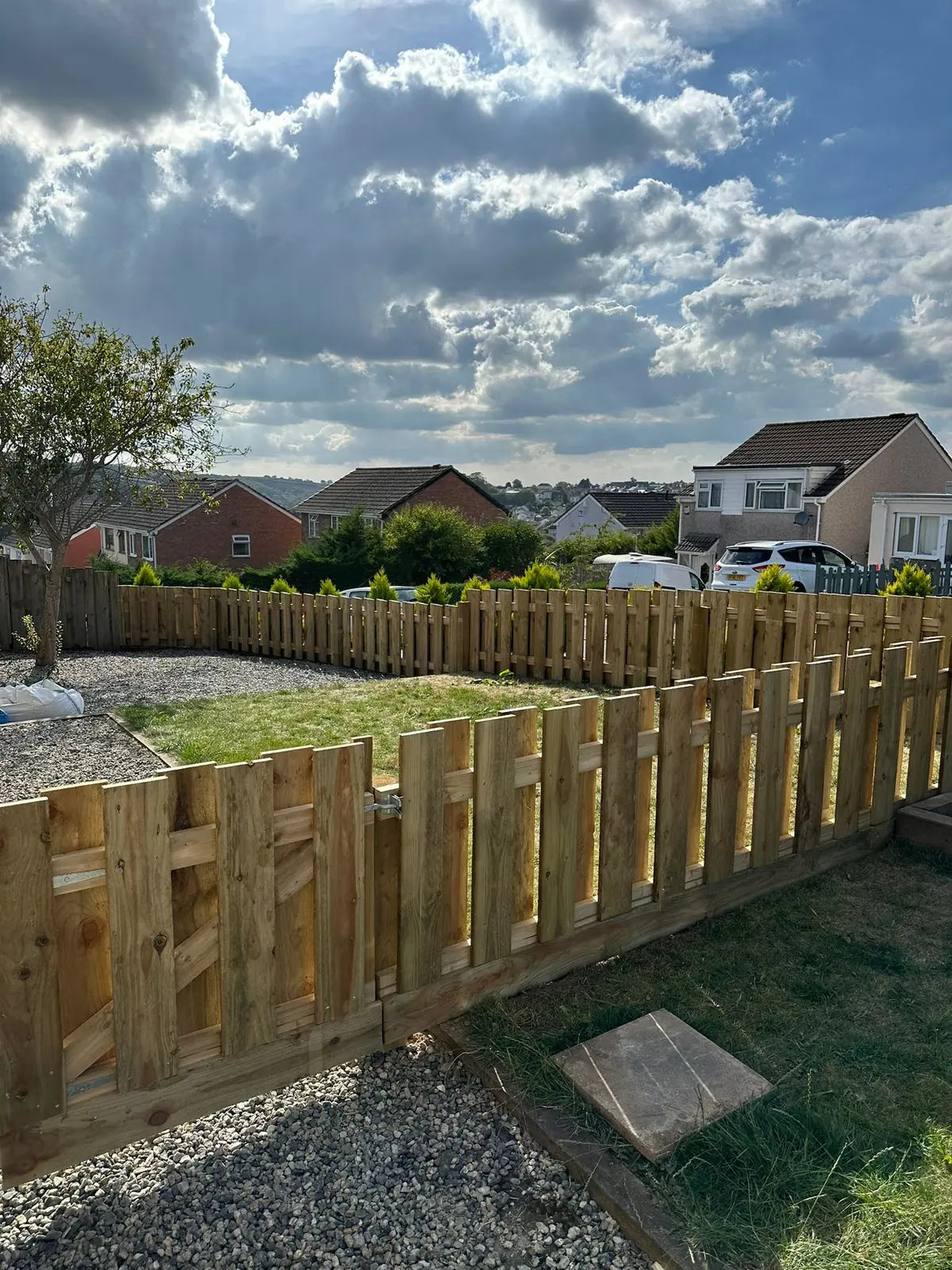
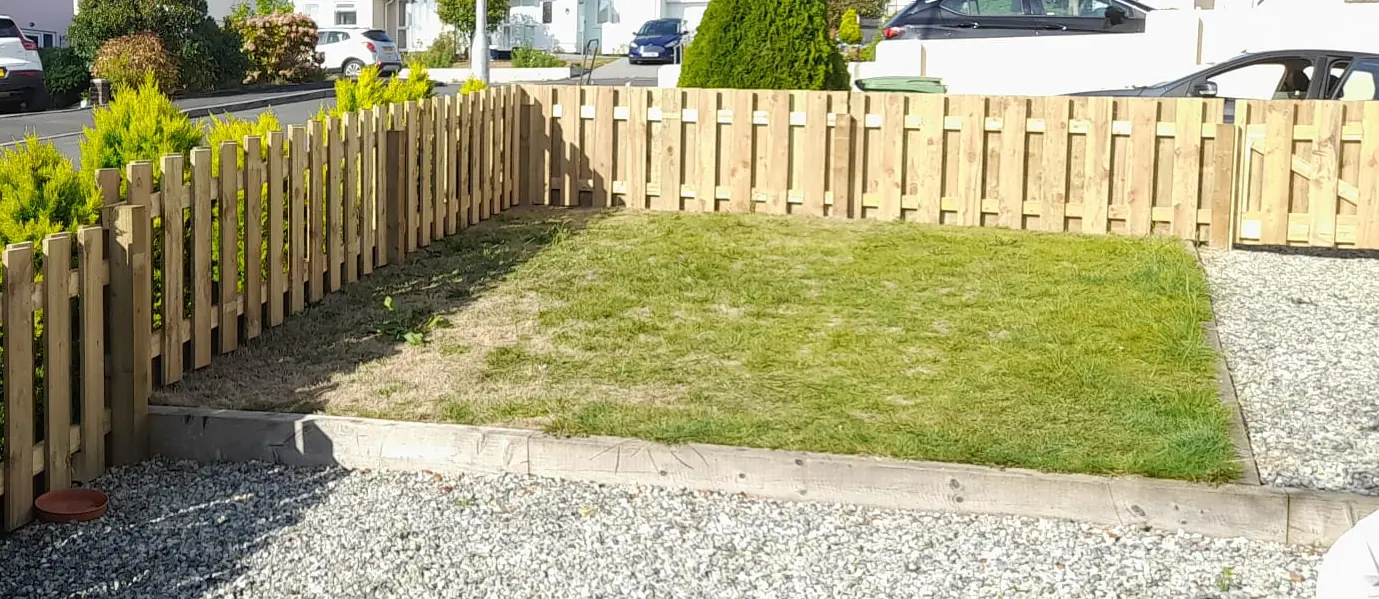
Hit and miss fencing is the go-to choice for exposed and windy sites. Rather than a solid run of boards, the pales are fixed alternately to the front and the back of the rails, with a gap between each board. The result is a fence that looks substantial from an angle, breaks up the view of what is behind it, but allows the wind to pass straight through the gaps.
Because the wind can flow through, the load on the fence is dramatically reduced. There is no sail effect, no sudden point of failure, and no constant battle against the weather. Hit and miss fencing is widely used on coastal and hilltop sites across Devon and Cornwall for exactly this reason.
For this project, it ticked every box:
- Wind permeable. The gaps let the gusts through, so the fence stays put in a storm.
- Dog containment. The gaps are narrow enough that a dog cannot push through, and the fence is sturdy enough to take the occasional lean or scratch.
- A clear, attractive boundary. At 1 metre high the fence is never going to screen the garden from view, but it clearly marks the boundary and softens the look of the front garden without boxing it in.
- Attractive. Hit and miss has a smart, contemporary look that suits a front garden far better than a plain panel fence.
The 1 Metre Highway Boundary Regulation
There was one more constraint on this job, and it is one that catches a lot of homeowners out. The fence was to run along the front boundary of the property, facing directly onto a lane. Under the Town and Country Planning (General Permitted Development) Order, a fence or wall adjoining a highway used by vehicles must not exceed 1 metre in height above ground level, without planning permission.
This is a national rule, not a local one, and it applies across England. For front boundaries that face a footpath only, the limit is also 1 metre if the footpath forms part of a highway. The 2 metre permitted development limit only applies to boundaries that do not adjoin a highway.
A lot of people assume they can put up a 6 foot fence at the front of their house. In most cases, they cannot, not without applying for planning permission first. We always flag this on the site visit, because it is far better to design the fence correctly from the outset than to build something too tall and have to take it down when the council comes calling.
For this Torrington project, we designed the fence to sit at the maximum permitted height of 1 metre, which gave the customer as much containment and boundary definition as possible while staying fully compliant. No planning application was needed.
Building the Fence: Cut to Size on Site
Because the fence was being built to a specific height limit, we cut every component to size on site rather than using off-the-shelf panels. This is one of the real advantages of a bespoke fence over a panel fence. You are not constrained by the standard heights that panels come in. You can build exactly to the height the site and the regulations allow, and not a millimetre less.
Posts and Rails
We set the posts at the correct centres for the run, concreted in to a depth appropriate for the exposed location. On a windy site, post depth is critical. A shallow post in soft ground will work loose over time as the fence flexes in the wind. We went deeper than we would for a sheltered garden, and domed the concrete at the top of each hole so water runs away from the post rather than pooling around it.
The rails were fixed between the posts at the correct spacing for a 1 metre fence, giving a solid frame for the hit and miss pales.
The Hit and Miss Pales
The pales are what give a hit and miss fence its character and its wind-permeable performance. We fixed them alternately to the front and rear face of the rails, with a consistent gap between each board. The gap width is a balance: too wide and you lose the visual break-up and dog containment, too narrow and you lose the wind-permeable benefit. We use a gap that gives the best of both.
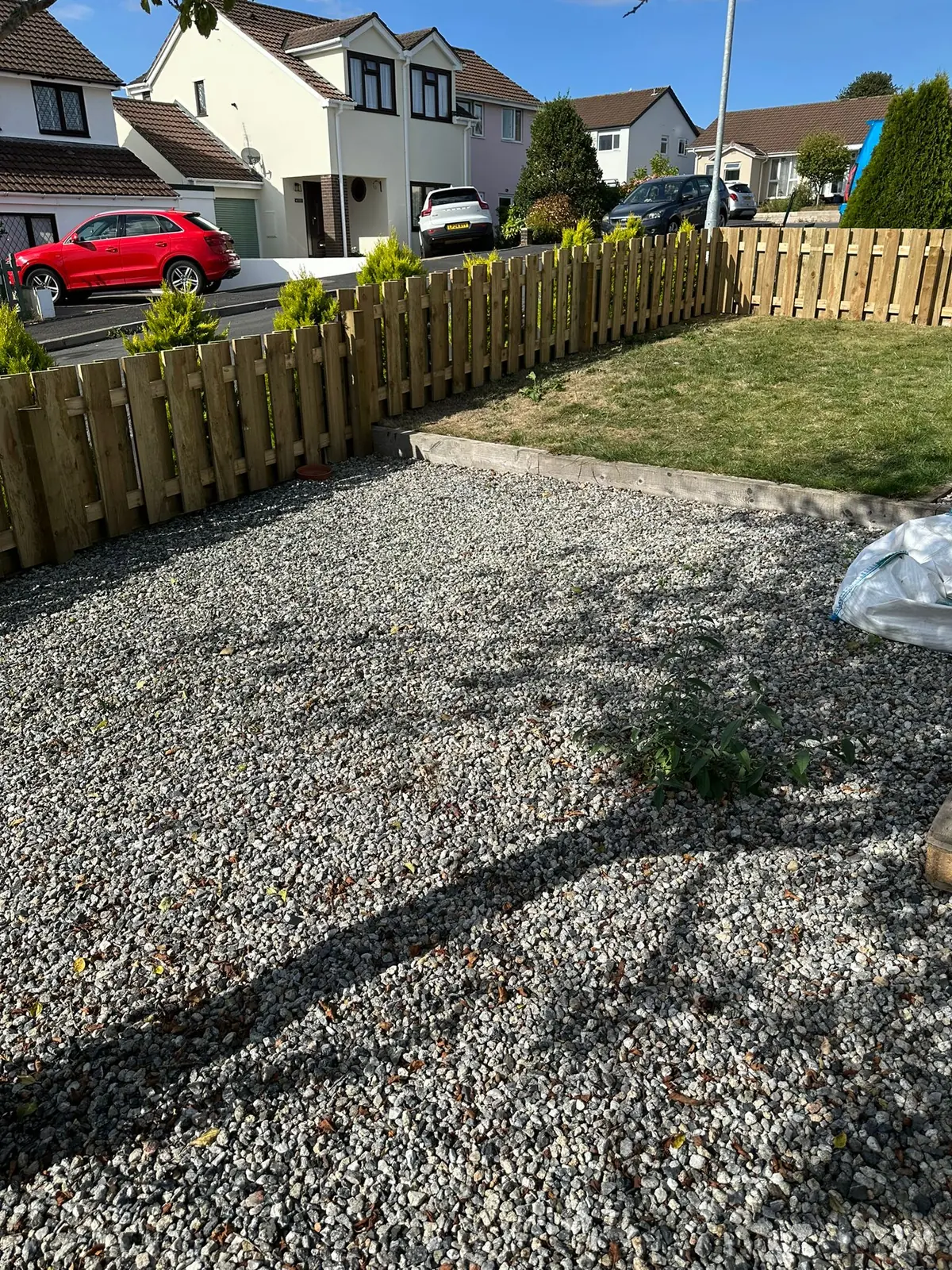
Every pale was cut to length on site so the finished fence sat at exactly 1 metre, level along its full run. Cutting on site also lets us follow the ground, which on a hilltop property is rarely perfectly flat. The top of the fence runs level, while the bottom follows the contour of the garden, keeping the dog in and the look consistent.
The Matching Gate
A hit and miss fence deserves a gate in the same style, and that is what we built. The gate was made to match the fence, with the same pales fixed alternately to a sturdy frame, hung on heavy duty hinges, and fitted with a secure latch. A matching gate finishes the job off properly and avoids the jarring look of a mismatched gate tacked onto a bespoke fence.
The gate was also kept within the 1 metre height to stay consistent with the fence and the highway boundary regulations.
The Finished Result
The finished fence transformed the front of the property. It gives the customer a secure area to let the dog out and a clear, attractive boundary between the garden and the lane, all without the closed-in feel of a tall solid fence. From the street, the hit and miss pattern looks smart and considered, and it lets light and air through rather than throwing a solid shadow across the garden.
Most importantly, it is built for the conditions. When the next winter gale rolls in off the Atlantic and up the Torridge Valley, this fence will not be the one we get called out to replace.
What the Customer Said
We always appreciate honest feedback, and this review, left on our Google Business Profile, sums up what we aim for on every job:
Really thrilled with the new fence and repair of the old fence. Nathan did an excellent job. First rate workmanship, friendly and respectful. I will definitely be contacting Nathan for the next garden project and have no hesitation in recommending him.
The customer also rated the price as great value, and listed the work as custom fence construction and wood fence installation. That combination, a bespoke fence built to fit the site and the regulations, at a fair price, is exactly what we set out to deliver.
Why Hit and Miss Fencing Works Across North Devon
Great Torrington is not the only exposed spot we work in. The same wind-permeable principle applies anywhere in North Devon where a solid fence would struggle:
- Coastal properties in Instow, Appledore, and Abbotsham, where salt-laden gales test every boundary.
- Hilltop and ridge sites around Great Torrington, Hatherleigh, and Holsworthy.
- Open farmland edges in the villages west of Barnstaple, where there is no natural windbreak.
- Front gardens anywhere adjoining a highway, where the 1 metre limit rules out a tall solid fence but you still want a proper boundary and dog containment.
If your garden catches the wind, hit and miss fencing is almost always the better long-term choice over a solid panel fence. It costs a little more to build because every pale is cut and fixed individually, but it lasts because it is designed for the conditions it will face.
Find out more about our fencing services across Barnstaple and North Devon.

About Nathan
Nathan has spent more than 10 years installing and repairing fences, gates, and garden structures across North Devon. He takes a practical, detail-first approach to every project, specifying materials and designs that are properly suited to the coastal and hilltop weather around Barnstaple, Bideford, Great Torrington, and Ilfracombe.
Learn more about NathanNeed a Wind-Permeable Fence in North Devon?
If you live on an exposed site in Great Torrington, Bideford, Barnstaple, or anywhere across North Devon, and you want a fence that will stay standing in the wind, Barnstaple Fencing can help. We design and build fences that are properly specified for the conditions, not just the cheapest option that will get blown down next winter.
Contact us today for:
- Custom hit and miss fencing for windy and exposed gardens
- Front garden fences built to comply with the 1 metre highway boundary limit
- Matching gates in any style
- Fence repairs and replacements
Call 01271 626340 or contact us online for your free, no-obligation quote.
Serving Great Torrington, Bideford, Barnstaple, Hatherleigh, Holsworthy, Ilfracombe, and surrounding North Devon areas with professional, reliable fencing services you can trust.