If there's one thing North Devon gardens have in abundance, it's slope. From the rolling hills around Barnstaple and Bishops Tawton to the steep coastal banks above Ilfracombe and Woolacombe, genuinely flat garden space is a rarity. For homeowners staring at an unusable bank or a lawn that disappears downhill, decking is often the most practical way to reclaim that space and turn it into something you can actually use.
But building a deck on sloping ground is a different proposition from laying one on a level patio. The subframe has to work harder, drainage matters more, and getting the levels right is the difference between a deck that feels solid and one that bounces underfoot. This guide walks through the key decisions and the pitfalls to avoid when installing decking on a sloping North Devon garden.
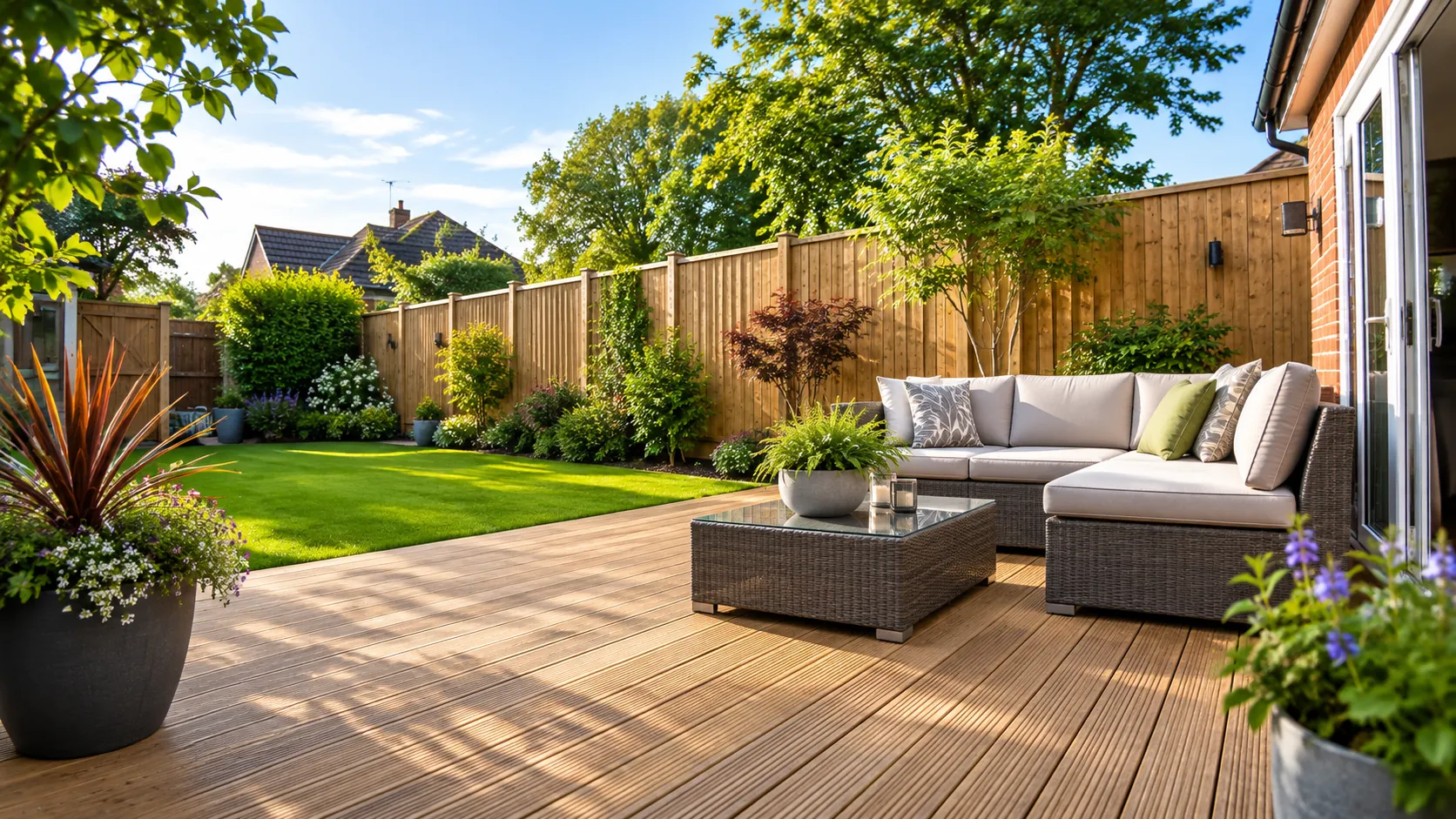
Why Decking Suits Sloping Gardens
A lawn on a slope is a struggle. Mowing it is awkward, the soil washes downhill in heavy rain, and the space is too uneven for furniture or a barbecue. Paving is an option, but it requires significant groundworks, retaining walls, and hard-core to build up a level surface, which gets expensive quickly.
Decking sidesteps all of that. Instead of moving earth to create a flat surface, you build a level platform above the slope. The subframe follows the contour of the ground, with support posts cut to varying lengths so the top of the deck sits perfectly horizontal. What was an awkward bank becomes a clean, usable outdoor room.
For North Devon properties, where many homes sit on hillsides or have gardens that drop away from the house, this is often the single most effective way to add usable outdoor living space without major excavation.
The Subframe: Where a Deck Succeeds or Fails
The part of the deck you never see is the part that matters most. A deck on sloping ground relies entirely on its subframe, and a poorly designed subframe is the number one reason decks fail prematurely.
Joist Size and Spacing
The joists are the horizontal timbers that carry the boards. On a ground-level deck, a standard 150mm by 47mm treated joist at 400mm centres is usually adequate. On a raised deck where the subframe is supported on taller posts, the span between supports needs to be reduced or the joist size increased to prevent flex. If the joists are undersized, the deck will feel springy underfoot and the boards will start to cup and lift at the joints.
Support Posts
On a slope, the support posts carry the weight of the deck down to the ground. Each post needs to be set in concrete, deep enough to be stable and below the frost line. In North Devon's wet clay soils, that typically means digging at least 600mm down. Posts should be treated to Use Class 4 for ground contact, and the concrete should be domed at the top so water runs away rather than pooling around the timber.
Bracing
Any deck that sits more than 600mm above ground level at any point needs diagonal bracing between the posts and the subframe. Without it, the structure can sway sideways under load or in high winds. This is particularly important for exposed coastal gardens around Croyde, Saunton, and Woolacombe where wind loading is significant.
Drainage and Airflow
Timber left sitting in standing water rots. It's the simplest rule in decking, and it's the one most often ignored.
On a sloping site, water tends to collect at the low end of the garden or against retaining walls. Before the subframe goes in, the ground beneath should be graded so that water flows away from the deck area, not underneath it. A layer of weed membrane and gravel beneath the deck suppresses plant growth and helps keep the area dry.
The subframe itself needs airflow. Posts should be set on pads or concrete blocks that lift the timber clear of the soil, and the deck should have a gap around its edges so air can circulate underneath. A deck that's sealed in at the sides with no ventilation will trap moisture and start decaying from the underside, where you can't see it happening.
Choosing the Right Decking Material
The slope of your garden doesn't change which material works best, but it does affect how the deck is used and how much maintenance you're willing to take on.
Pressure-Treated Softwood
Scandinavian redwood is the most popular decking material in North Devon and for good reason. It's affordable, easy to work with, and treated to Use Class 4 for ground contact. With a fresh coat of preservative every two to three years, a softwood deck will comfortably last 15 years or more. It's the sensible default choice for most Barnstaple gardens.
Hardwood
Dense tropical timbers like balau and iroko are naturally resistant to rot, insects, and moisture without any chemical treatment. They cost more upfront but age into a silver-grey patina and can outlast softwood by decades. For exposed coastal decks where salt air and damp are constant, hardwood is a genuine long-term investment.
Composite
A blend of wood fibres and recycled plastic, composite boards don't rot, splinter, or need staining. They're the lowest-maintenance option and come in a wide range of colours and grain effects. The higher initial outlay pays off if you want a deck you can use year-round without ever picking up a paintbrush. On a sloping garden where access for maintenance is tricky, composite is worth serious consideration.
Planning Permission for Raised Decking
Most domestic decking in North Devon doesn't need planning permission, but raised decks have specific rules to be aware of.
Under permitted development, decking is allowed without an application provided three conditions are met. The deck must not sit more than 30 centimetres above ground level at any point. It must not cover more than half of the total garden area around the house. And it must not be placed on land in front of the principal elevation of the property.
The 30 centimetre rule is the one that catches people out on sloping gardens. If your garden drops away sharply, a level deck that sits 50 centimetres above the ground at the low end will need planning permission, even if it's only 10 centimetres above the ground at the high end. The measurement is taken from the highest point of the deck to the natural ground level directly below it.
If your home is listed or in a conservation area, different rules apply and you should check with North Devon Council before starting any work.
Maintenance: Keeping Your Deck Sound
A deck on a slope is no harder to maintain than one on flat ground, but there are a few things worth keeping on top of.
Sweep regularly. Leaves and debris that sit on the deck through winter hold moisture against the boards and encourage algae growth. A quick sweep every few weeks keeps the surface clean and dry.
Check the subframe annually. Once a year, get underneath and have a look at the posts, joists, and fixings. Look for soft spots in the timber, rust on the screws, and any movement in the structure. Catching a problem early is far cheaper than replacing a rotted subframe.
Re-treat softwood every two to three years. A quality wood preservative or decking stain applied on a dry day will keep the timber protected and looking good. Hardwood and composite don't need this.
Keep the gaps clear. The small gaps between boards are there to let water through. If they get clogged with debris, water sits on the deck instead of draining away. Run a scraper or pressure washer along the gaps once a year.
Getting the Levels Right
The single most important skill in building a deck on a slope is getting the levels right. The deck needs to be perfectly horizontal, but it also needs to connect sensibly to the house, the garden, and any steps or pathways. A deck that's level but sits too high or too low relative to the back door is awkward to use.
If you're planning a raised deck on sloping ground and you want it built properly, with a subframe engineered for the load and the conditions, it's worth talking to someone who does this regularly. We install decking across Barnstaple, Bideford, Ilfracombe, and the surrounding area, and we're happy to come out, take levels, and give you honest advice on what's achievable.
Find out more about our decking installation service in Barnstaple

About Nathan
Nathan has spent more than 10 years installing fences, decks, and garden structures across North Devon. He takes a practical, detail-first approach to every project, using materials that are properly specified for the coastal weather around Barnstaple, Bideford, and Ilfracombe.
Learn more about NathanPlanning a Deck in North Devon?
Whether your garden slopes gently or drops away sharply, we can help you turn it into usable, level outdoor space. Get in touch for a free site visit and a fixed written quote.
Call 01271 626340 or contact us online to arrange a consultation.
Serving Barnstaple, Bideford, Ilfracombe, South Molton, and surrounding North Devon areas with professional decking installation built to last.